Process Mining finds every problem. But not the cause.
Process mining needs a foundation. Most companies don't have one.
The idea is compelling. A software tool reads the event logs from a company's IT systems, reconstructs the real process flows from them, and at a glance shows where things get stuck, where loops arise, where cycle times explode. Celonis, Signavio, UiPath. The tools are powerful, the promises big, the demos impressive.
And then the technology meets reality.

Prof. Dr. Nicolas Burkhardt
CEO & Founder
The Promise and the Prerequisite
Process Mining works where processes run digitally. In an ERP, a CRM, a ticketing tool. Everywhere every step leaves a digital footprint, an event log the mining engine can read.
In most companies, however, not all processes run digitally anymore. Procurement may work cleanly in the ERP, but approvals happen by email, the follow-up question goes by phone, and the special approval sits in an Excel spreadsheet that someone once saved on the drive. At these points there are no event logs. And where there are no logs, Process Mining is blind.
Before a company can use Process Mining meaningfully, it must understand where its own processes are digital enough to be mined. And where they are not. That sounds trivial, but in practice it is anything but. Because most companies do not even know how their processes actually run. They know how they should run according to the manual. They know what the last consulting project documented. But how procurement at the Dortmund branch really handles the ordering process, which steps run digitally and which through the grapevine, nobody knows centrally. Certainly not at the push of a button.
The Project Before the Project
Here lies the real problem, and it is more expensive than most people think.
A company decides to do Process Mining. Licenses are negotiated, an implementation partner is selected, a project plan is drawn up. And then in the first weeks the project team realizes it cannot answer the most basic questions. Which systems run which processes? Where are there clean event logs and where do the digital traces end? Which processes are mature enough to be mined at all, and which exist in a mix of system, email, phone, and shouted requests that no mining tool in the world can capture?
The project team starts mapping. Interviews with business units, workshops with IT, alignment of system landscape and process documentation. This inventory alone takes weeks, sometimes months, and consumes a significant part of the budget before a single process has even been mined. The enablement project becomes the project before the project. And because the effort is so great, the whole thing is often limited to a small slice: order-to-cash in the ERP, the procurement process in SAP. Everything else is left out because it would blow the scope.
What is frustrating about this: The insights from this mapping are enormously valuable. Understanding where processes run digitally and where they do not, where media breaks occur, where informal paths replace official ones—that is knowledge every organization needs, regardless of whether it wants to use Process Mining or not. But this knowledge is rebuilt from scratch every time, for every project, every department, every consultant.
In essence, companies are missing something very simple. They are missing a map.
Google Maps Without a Map
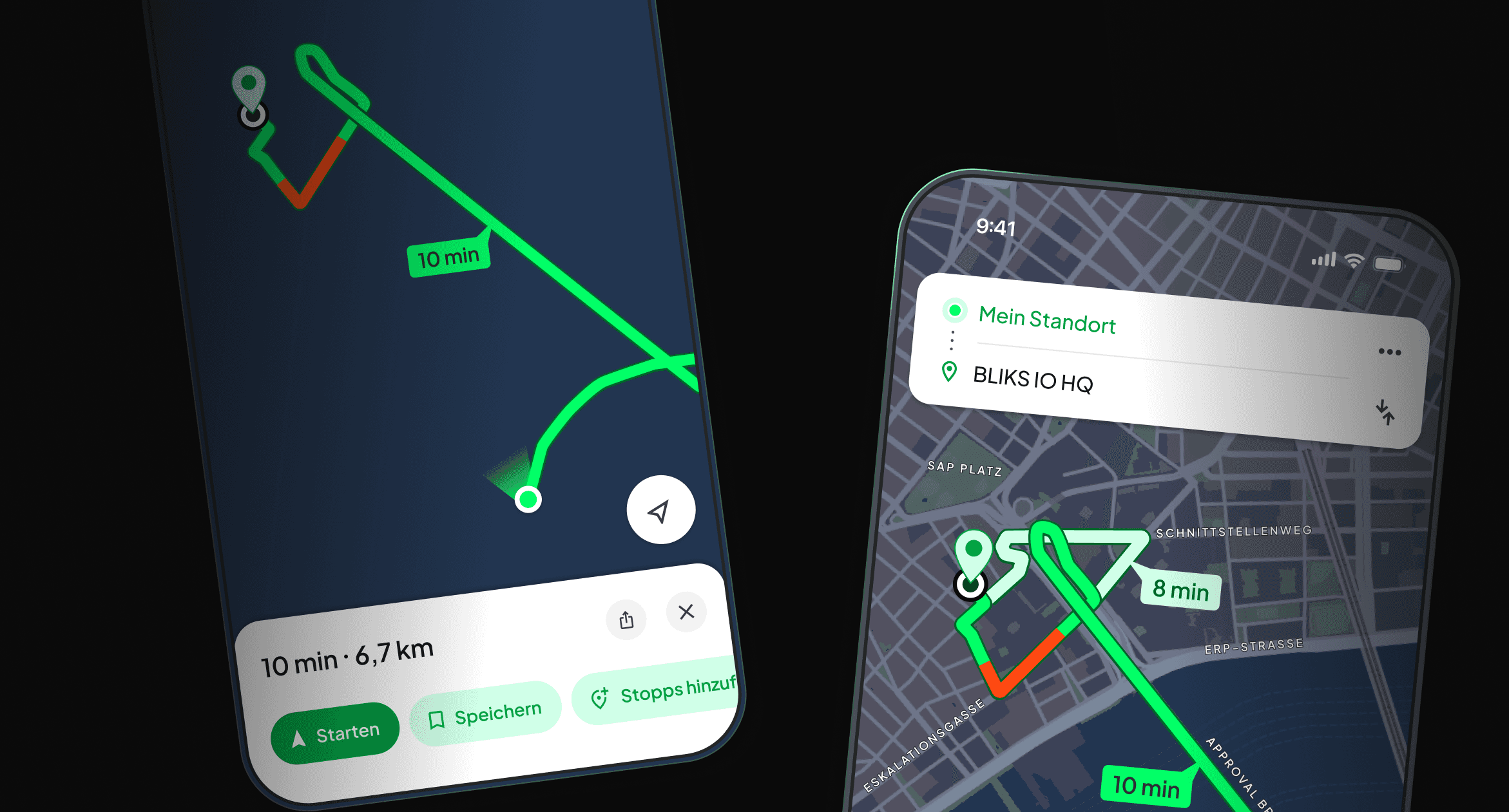
Everyone knows Google Maps. The route from Munich to Hamburg, drawn in blue, with travel times and yellow and red sections depending on traffic. You can immediately see where traffic flows, where it slows down, and when you will roughly arrive.
Process Mining does exactly that for business processes. It shows the route, the actual sequence, and the performance along with it. Where things move quickly, where they get stuck, and where loops emerge that nobody planned.
Now imagine you open Google Maps and all you see are lines. Routes with travel times, but nothing underneath. No roads, no buildings, no rivers, no intersections. Just lines on a white background.
You see that the route between kilometer 340 and 360 is red. Something is slowing it down there. But is there road construction? Does the route go over a bridge that can only be driven on in one lane? Do three highways converge at a junction? Without the background map, you know there is a problem, but you do not understand it. And what you do not understand, you cannot solve.
That is exactly how companies work with Process Mining today. They see the routes and the bottlenecks, but they lack the layer underneath. The map that explains why the process runs the way it does.
And even more serious: without a background map, a company does not even know on which routes it can calculate routes at all. Where does the road end and where does a dirt road begin that no navigation system knows? The background map is therefore doubly relevant. It explains the route where it exists. And it shows where no route is possible because the infrastructure is missing.
What Lies Beneath the Routes
Process Mining has a structural limit. It can only see what systems log. As soon as a process leaves the system because someone picks up the phone, writes an email, or speaks to a colleague in the hallway, the data chain breaks. The route turns red, and nobody knows why.
These points are often the most interesting ones in the whole company. Where the process moves from ERP to Excel, from software to phone, from digital workflow to handwritten note, that is exactly where the real levers for digitalization and automation lie.
A concrete example. A company sees in Process Mining that the lead time in the procurement process between demand notification and order release is six days on average instead of the planned two. The route is deep red. The system shows: the demand notification comes in, then nothing happens for six days, then the order is released.
Six days of silence.
What actually happens: The request is waiting for approval, which runs by email. The department head is on a business trip for three days; their deputy does not know they are responsible. On Wednesday, the department head sees the email among 47 others. On Thursday, someone asks again. On Friday, approval is granted. Six days, none of them visible in the system.
That is the terrain under the route. The rivers, bridges, and intersections that explain why traffic flows the way it does.
Two Layers, One Picture
Process Mining and what lies beneath the routes are not competitors. They are two layers of the same map. After all, you do not use Google Maps for the route and Apple Maps for the terrain. You want to see both together, in one image, because only the combination creates orientation.
One layer shows the performance: How do processes actually run, where do they deviate from the target state, where do bottlenecks arise? The other layer shows the context: Which roles are involved, which systems are used where, and where does the process leave the digital space?
Only when both layers are overlaid does a usable picture emerge. Then a company sees the red section on the route and at the same time understands that three departments are tied up here because of unclear responsibility. Then it sees the loop in the process and recognizes that a media break between two systems forces employees to transfer data manually.
Without a background map, Process Mining shows where things get stuck. With a background map, a company understands why. And only then can it act in a targeted way.
Where the Map Comes From
Most companies do not have this background map. They have organizational charts that reflect the target state, and process documentation that was created during the last audit and has not been touched since. And they have the knowledge of their employees, spread across hundreds of heads, not centrally accessible anywhere.
Exactly for that reason, BLIKS IO exists.
BLIKS IO goes where Process Mining ends: to the people who live the processes every day. Which steps run digitally, which run through side channels? Where are the media breaks and informal workflows, where are the responsibilities that are clear on paper but not in practice? BLIKS IO structures this knowledge with AI support into a digital twin of the organization. The background map that did not exist before.
For Process Mining, that means two things. BLIKS IO shows where mining can take effect and where the prerequisites still need to be created. The mapping that companies need weeks and months for today, the project before the project, is delivered immediately by the digital twin. Which processes are digital enough for event logs? Where do the system traces end? Where does the use of Process Mining pay off, and where is the level of digitalization not yet far enough? With these answers, a Process Mining implementation becomes leaner, faster, and more focused because the project team knows from day one where it can start.
And in the places where the route stays red and no system can explain why, BLIKS IO provides the terrain beneath it. The context that turns a red line into a solvable task.
Map and Route
Process Mining has changed the way companies look at their processes. But a route without a map remains a line in emptiness. And without a map, you do not even know where routes can be calculated at all.
BLIKS IO delivers the terrain beneath it. So that companies know where Process Mining can start. And so that the red spots on the route finally get an explanation.

Stay up to date with our newsletter:

BLIKS IO
Operational Reality. Digitally Recorded.