Box Box Box. Organizational transformation at 300 km/h.
No overtaking in curves!

Jonas Neubauer
Co-Founder & CGO
Lap 54. Wet track, but the line is drying.
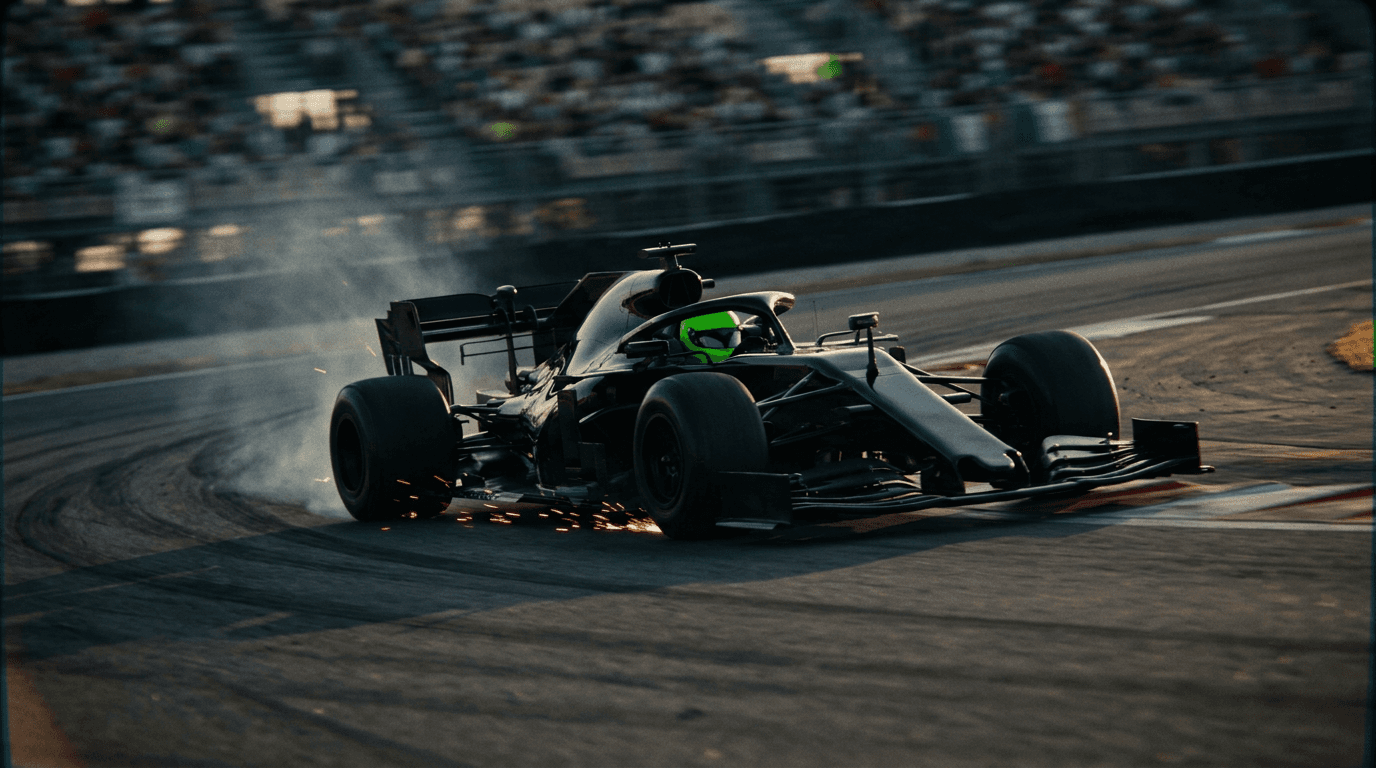
Max Verstappen feels it in every corner. The wet-weather tires are no longer carrying him; they are slowing him down. The conditions have changed.
In Formula 1, everything is decided in the corners. Not on the straight, where everyone goes flat out. But where speed and direction change at the same time. That is where victory is separated from defeat.
“Box box box" crackles over the pit wall into his helmet. Three words. No doubt. “Copy." Verstappen steers into the pit lane. 2.1 seconds. Slicks on. Out.
A tire change is never just a tire change. New tires mean different braking points, different cornering speeds, a different feel for the car. The engineers adjust the wing setting, correct the brake balance, and recalculate the fuel load for the remaining laps. Every change triggers the next one. Only when everything is aligned can Verstappen attack Lando Norris.
That is how organizational transformation works too. Or better: That should be how it works.
A Formula 1 car is an organization
The track is not something anyone lets you choose. It is there. Monza with its long straights. Monaco with its tight corners. The track is the market in which a company operates. Regulation, economic conditions, technological upheaval. Whether it rains or the sun shines, whether the asphalt is grippy or slick, is not decided by any team itself. The other cars on the track are the competitors. Some faster, some slower, all with their own strategies.
What a team can control is its own car. And a Formula 1 car is a system of hundreds of variables, all interconnected. Engine, aerodynamics, tires, brakes, fuel, suspension, electronics. No component exists in isolation. Each influences every other.
An organization works on the same principle. McKinsey summed this up in the 7S framework in the 80s: Strategy, Structure, Systems, Skills, Staff, Style and Shared Values. Seven dimensions that define every organization. And just like with an F1 car: turn one screw, and six others turn with it.
You change the strategy? Then structures have to adapt. Structures change? Then staffing no longer fits. Suddenly, people are sitting in positions that no longer match their capabilities. You introduce a new system? Then workflows shift, leadership styles have to adapt, and if you don’t take the shared values into account, you end up with an organization that is transformed on paper, but internally on the brakes.
Overtaking Happens in the Corners
Verstappen has his fresh slicks. He gets on the gas. But the race is not won on the straight. There everyone gives it everything. The race is decided in the corners. Where speed and direction have to be adjusted at the same time. Where millimeters decide seconds.
For companies, those corners are the moments of change: a restructuring, the automation of entire departments, an ERP migration, a shift in the business model. In these moments, everything has to be right. Not just the one lever you consciously pull, but the entire cascade you set in motion.
A concrete picture. Your company is migrating to SAP S/4HANA. So you are not changing the tires; you are changing the engine at full speed. And now this happens:
Sales has so far created quotes in the old ERP. Customer inquiry in, calculation in the system, quote out, order created. It worked for years. Now S/4HANA comes along, and suddenly the quote calculation runs differently. New interface, new logic, new integrations to the CRM. Sales reps need different skills. The team lead, who previously mainly monitored forecasts, is now supposed to do data-driven pipeline management. That is a different leadership style. At the same time, it turns out that three of the eight sales roles are no longer needed in their previous form. The sizing no longer fits. Employees notice that something fundamental is shifting, and the mood turns. The shared values, the unspoken "This is how we do things here," are suddenly called into question.
A system decision. Seven dimensions in motion.
In Formula 1, the strategist has already run this through in lap 30: switching to mediums on lap 42 means the fuel won’t last to the end. So the first stop has to be brought forward to lap 38, the driving strategy up to that point has to be switched to efficiency, and the second stop has to be completely replanned. Every decision has second- and third-order consequences. Anyone who doesn’t think it through in advance loses control.
300 Sensors. No Gut Feeling.
More than 300 sensors are built into a modern Formula 1 car. They measure tire temperature, brake wear, engine performance, drag, fuel consumption per corner. This data flows in real time to the pit wall, where engineers and strategists evaluate every piece of information. When the race strategist radios “Box box box,” he has read the data. He knows what happens if he switches now. And he knows what happens if he doesn’t.
Most organizations do not have these sensors. They start transformations based on assumptions, outdated org charts, and slide decks from the last strategy workshop. They change the engine without knowing the effect on the aerodynamics. They change the suspension without knowing how it affects the brakes. They plan the pit stop by feel.
And then, at some point out on track, comes the corner. And the car breaks loose.
That is rarely because the idea was bad. The strategy was often right. The new engine was the right one. But nobody ran the cascade through. Nobody had all seven dimensions in view at the same time. Nobody knew that after the migration, sales would work 40 percent slower for three months, that the team lead would be overwhelmed, that the best people would start looking around.
The Missing Space
A Formula 1 team invests hundreds of millions in its Strategy Room. The room where all data comes together. Where engineers and strategists model cascade effects in real time, run scenarios, and make dependencies visible. Without this room, no race win would be possible. No team would even think of competing without it.
Organization transformation has so far been run without a Strategy Room. Consultants come in, do interviews, build presentations, deliver recommendations. Good recommendations, often. But a central system that makes all seven dimensions of an organization visible in their interdependencies, that shows the cascade before it happens? That did not exist.
Until now.
We built BLIKS IO so that this room exists. A digital twin of the organization that is not based on abstract models, but on the real knowledge of the people who live the processes every day. AI-supported, BLIKS IO captures and connects what belongs together: processes, systems, roles, structures, capabilities, leadership responsibility, and their interdependencies.
Before you change the tires, you can see what changes in brake balance. Before you swap the engine, you know which processes are affected, which roles shift, where the sizing tips. You see the cascade. Not after it has happened.
Consultants, interim managers, and companies use BLIKS IO as their pit wall. A system that gives them the transparency to steer transformation not by guesswork, but on the basis of real, connected organizational data.
Checkered Flag
In Formula 1, it’s not the fastest car that wins. It’s the team with the best coordination between all components. Speed without control is controlled chaos.
Organizational transformation is not a sprint on the straight. It is lap after lap, corner after corner, adjustment after adjustment. Whoever knows the seven dimensions of their organization, understands their interdependencies, and anticipates the cascade, wins the race.
It was time for a Monitoring Room. Not just for Formula 1.
For every organization that wants to win its transformation.

Stay up to date with our newsletter:

BLIKS IO
Operational Reality. Digitally Recorded.