Lean ends at the shop floor door.
The eight types of waste — and why five of them remain invisible outside of manufacturing.

Jonas Neubauer
Co-Founder & CGO
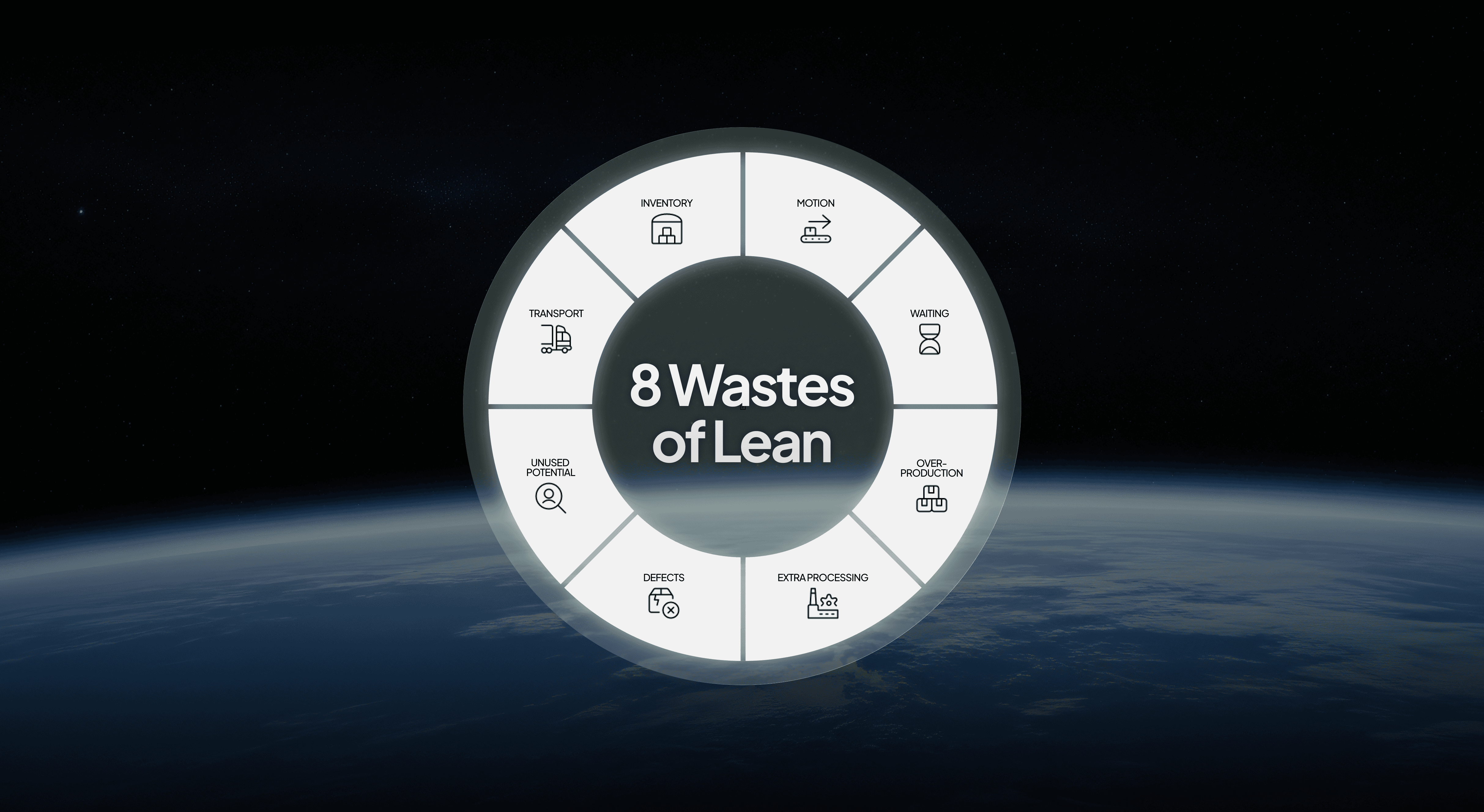
In almost every medium-sized company, the same poster is hanging: eight fields around a blue circle, and in each field a type of waste — overproduction, inventory, transport, motion, waiting, overprocessing, defects, and unused talent.
The "8 wastes" poster is right, and has been for fifty years without change.
And yet: ask outside of production how much waiting time occurred last week — in order processing, purchasing, HR. You won't get a number, but a shrug of the shoulders.
This is not a criticism of your people, but a measurement problem.
Taiichi Ohno had a shop floor as a measurement point
Ohno did not develop the seven wastes at Toyota at a desk; he saw them. The well-known story goes like this: He drew a circle on the shop floor, stood a manager inside, and made him watch production for hours — with no goal, no analysis task, he was simply supposed to watch.
What he saw was the production process itself. And that worked precisely because the process was visible.
Inventory lies there and can be counted, you can see the forklift driving, you can see how often someone walks around the machine, and you can see the assembly line standing still. Waste in manufacturing has a physical form: it takes up space, it makes noise, it gets in the way.
That's why Lean worked in production. An excellent methodology — as long as there is visibility.
Your order processing has no shop floor
Now take a quotation process, an investment approval, or the onboarding of a new employee.
The process starts in an inbox, moves to the ERP, and is exported from there as Excel because a field is missing in the system. It goes via Teams message to someone who is currently on vacation, comes back as a PDF, is manually re-entered, and then sits for three days in an approval step that someone introduced six years ago after a single incident.
Where would you draw your circle on the floor?
The process has no physical place to stand. At any given moment, it is in a different system and in a different head, which is why you cannot stand next to it and watch.
You can only ask — and anyone who asks gets the polite version.
Three out of eight survive the move to the office
The eight wastes apply in administration just as they do in manufacturing. However, they are not as easy to measure there, and that is not due to a lack of diligence, but because the traces are missing. Three of the eight types can still be grasped with some effort. The other five elude any recording, even though in total they cost significantly more.
What still halfway works: Inventory can be counted as long as open processes are sitting in a system and have a status there; as soon as they wait in an inbox or a personal folder, they disappear from any analysis. Motion can be captured where click paths and system changes are logged, which is more common in modern applications than suspected. And overproduction can be recognized by reports that are reliably generated and just as reliably not opened — the question of who actually reads a report is rarely asked and is usually quickly answered.
What remains invisible:
Waiting. The process is lying idle, but nobody is lying idle with it. Everyone involved is fully utilized, each individual works quickly, and yet days pass between receipt and completion. The time does not arise in the people, but between them — at the points where a process waits for the next processor to go through their list the next time. Because every utilization statistic looks at individual people and not the gaps between them, this time does not appear in any key figure. Ask those involved, and everyone is right: it was only with them for a short time.
Transportation. Ohno meant the movement of material; in the office, the counterpart is information that is carried by hand from one system to the next. The data record that is re-entered three times on its way through your company because two systems do not talk to each other does not just cost the minutes of input. It creates an additional source of error, additional coordination, and another place where the process grinds to a halt if the person responsible is not there. And because the transfer is booked as normal administrative work, it is not considered waste, but work.
Overprocessing. Almost every company has at least one approval level that was introduced after a single incident and has slowed down every process since — including the ninety-nine out of a hundred where there was never a risk. Ask why this level exists; usually nobody knows anymore, and that is exactly the problem. A control whose trigger no one can name can no longer be responsibly abolished by anyone. It remains because its abolition would be a risk and its continued existence seems not to be one.
Defects / Rework. The correction loop, which has long been accepted internally as "normal coordination effort," is not in any error report because it does not count as an error. An application arrives incomplete, questions are asked, the process goes back and starts its path again. The query itself takes two minutes, but costs the entire next processing cycle. Anyone looking for error rates finds nothing; anyone looking for loops finds them in almost every process that runs across more than two departments.
Unused Talent. By the way, the eighth waste was not Ohno's, it was added later — and it is the most expensive. This does not mean unmotivated employees, but qualified people who spend half a day reconstructing what someone else in the building knew long ago. They search for the latest version of a calculation, ask three colleagues how a special case was handled last time, and end up rebuilding something that already existed. This time does not appear in any statistics because it looks like work — and because nobody has a reason to report it.
Five out of eight. No smaller than the other three, but invisible.
"But we know how our processes run"
Take a test that takes ten minutes.
Take a process that runs regularly and touches several departments, and ask three involved people independently of each other how it runs. Not how it is supposed to run, but how it actually runs.
You will get three versions, and all three are correct — each for their own section.
Nobody has the whole process in their head, and that is not negligence, but the normal result of division of labor: everyone knows their part well and the neighboring parts approximately.
The problem with this is that waste almost never arises within a section, but at the transitions between them — so exactly where nobody is looking because it is nobody's responsibility.
What follows from this
The answer is not another Lean training, because the definitions have been clear for fifty years and your people know them.
The answer is an AS-IS model — not a quality management manual or a PDF from the last consulting project that started to age the day it was approved, but a representation of what actually happens: with all handovers, system breaks, and waiting loops that nobody wanted to write down.
Ohno needed a chalk circle for this. In an organization where value creation runs through inboxes, systems, and heads, you need something else.
How BLIKS IO makes this waste visible and evaluable
This is exactly what BLIKS IO was built for, and capturing the processes is the minor part. Processes, roles, IT systems, and resources are not described as a text document, but are captured as a connected model of your organization — a digital twin that records who processes which step with which system and to whom they hand it over. Because this model is maintained continuously during operation and is not filed away as a project result, it does not lose its validity even after the first restructuring.
But the real benefit lies not in capturing, but in the evaluation. Once the connections between processes, roles, and systems are in place, the five invisible types of waste can no longer just be suspected, but counted — without a single stopwatch.
For example, it becomes visible how often a process changes ownership within a single process, because each of these handovers is a potential queue. It becomes visible where information crosses a system boundary and therefore must be transferred by hand. It becomes visible which activity appears almost identically in four different processes without anyone noticing before. And it becomes visible which steps depend on exactly one role — i.e., the places where a vacation halts the entire process.
You do not have to reconstruct these questions in workshops; you can ask them directly to the model. BLIKS Omniscient, your AI agent, answers them in natural language: Which processes depend on this role? Which system touches the most process steps? Where do most handovers converge? This turns a discussion about how things might be into a query with a result.
This shifts the order of your work. You no longer discuss which waste you suspect, but decide based on a list which one you will tackle first. And because every project needs the same foundation — a reliable picture of how your company actually works — you unlock both at once: the waste of today and the prerequisite for everything that is to be automated afterwards.
Ohno would have wished for BLIKS IO!
Stay up to date with our newsletter:

BLIKS IO
Operational Reality. Digitally Recorded.